



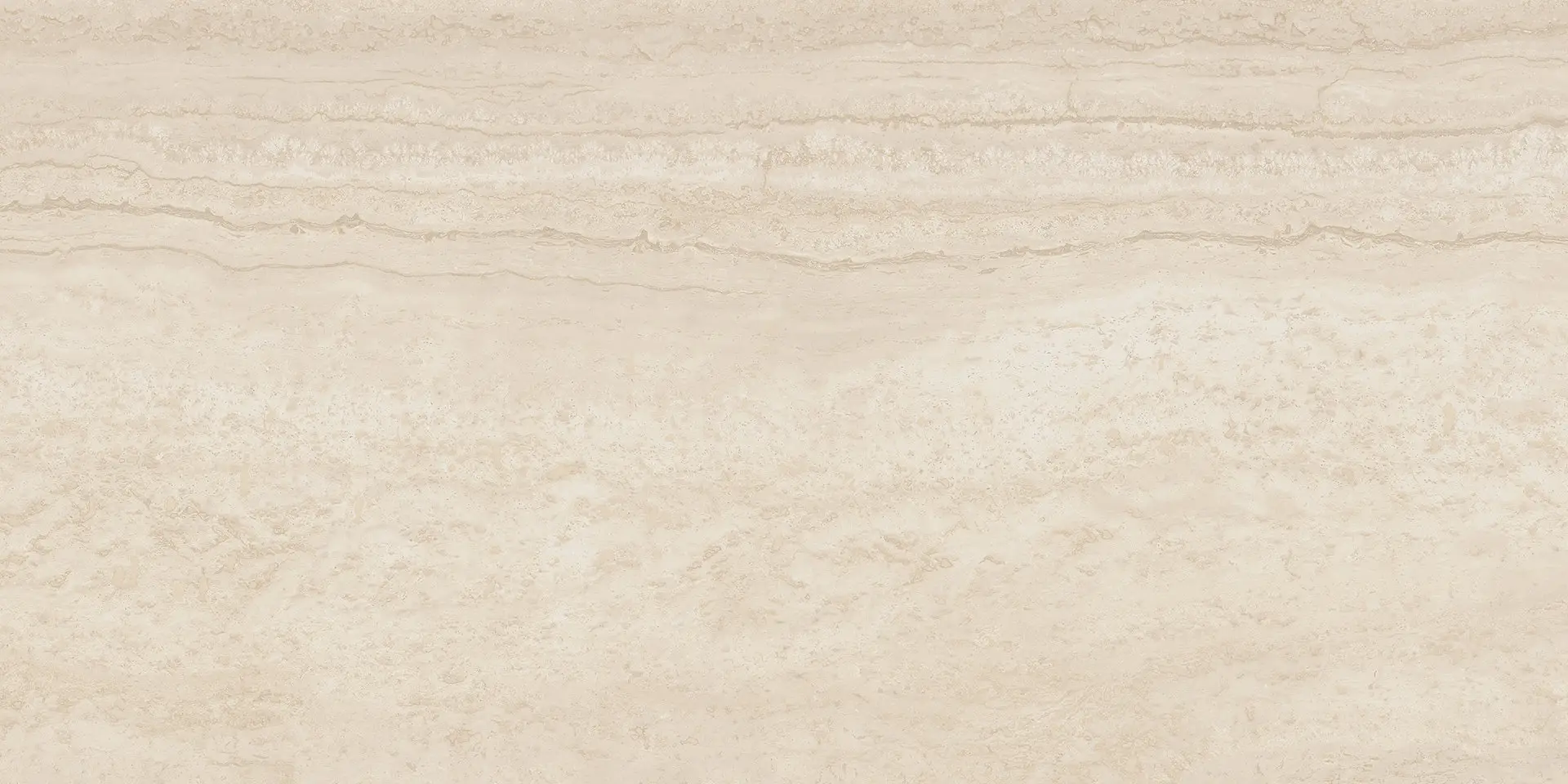
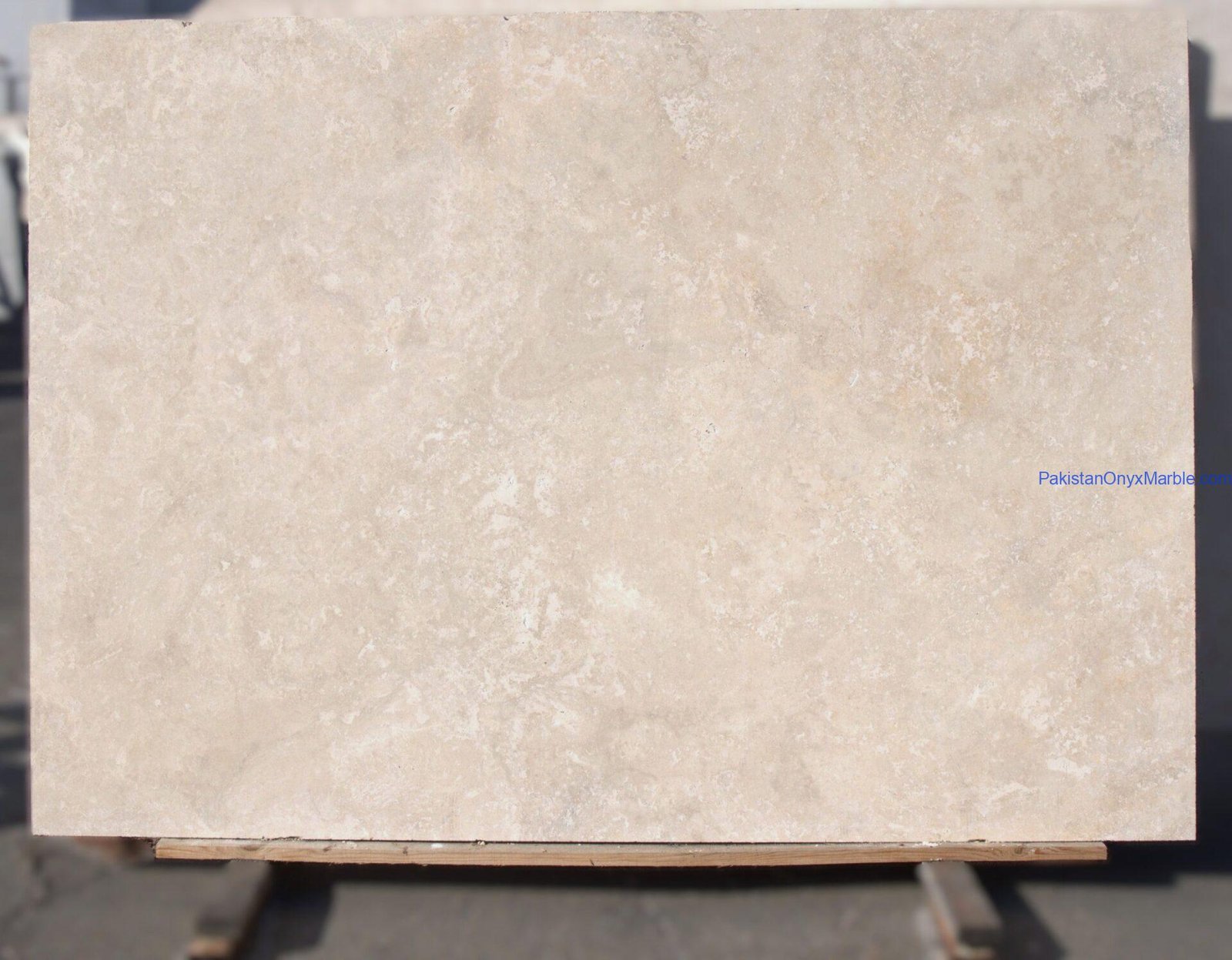
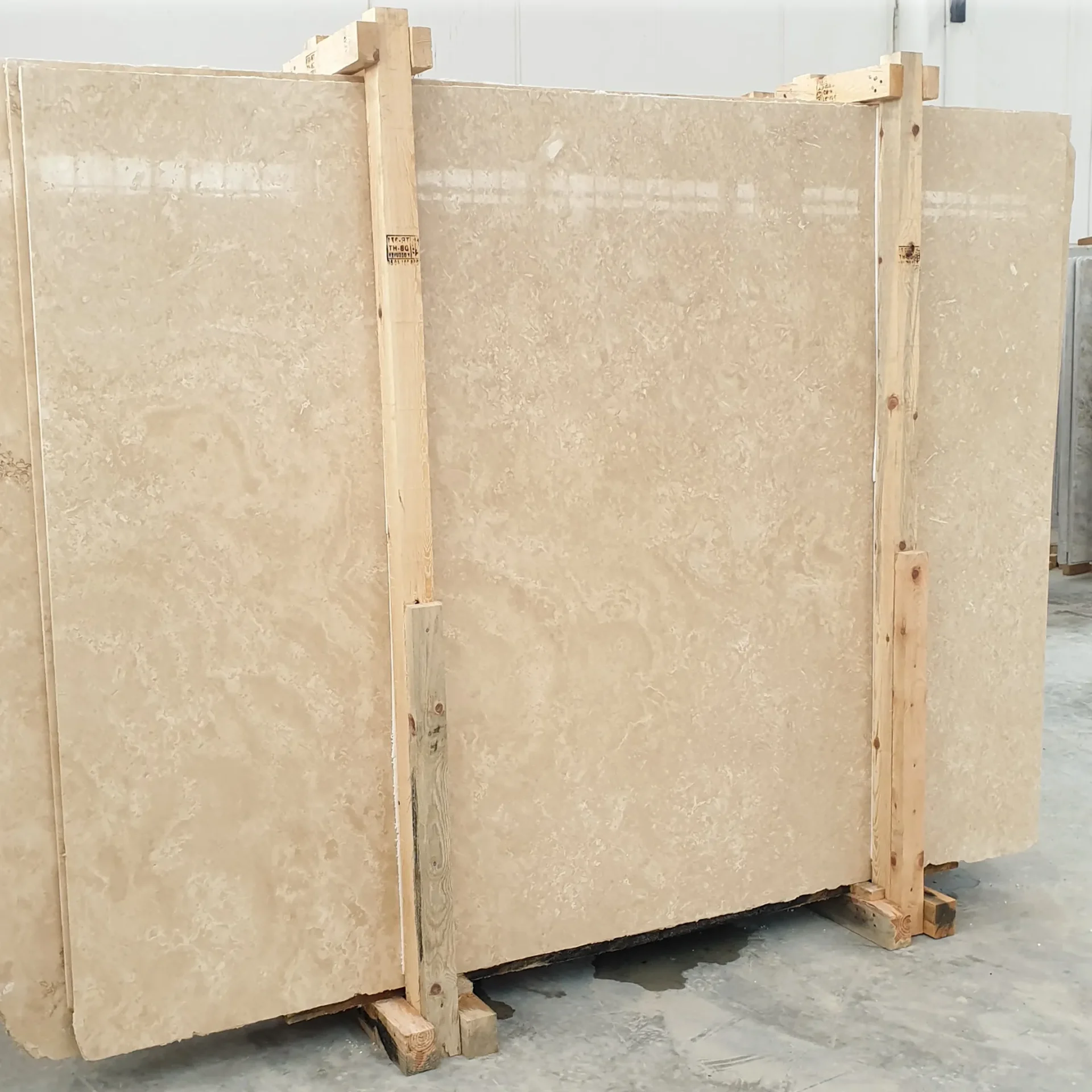
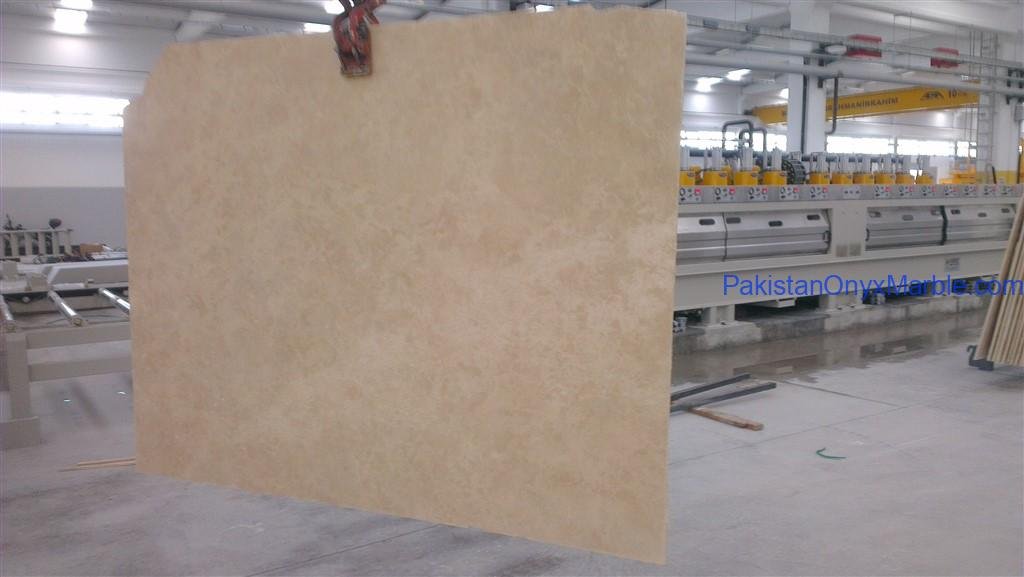
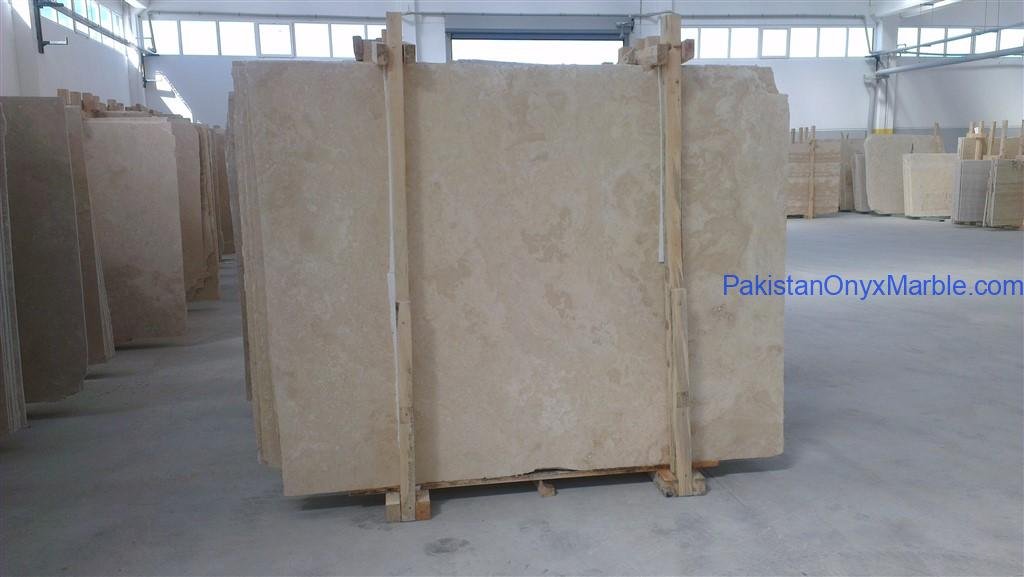
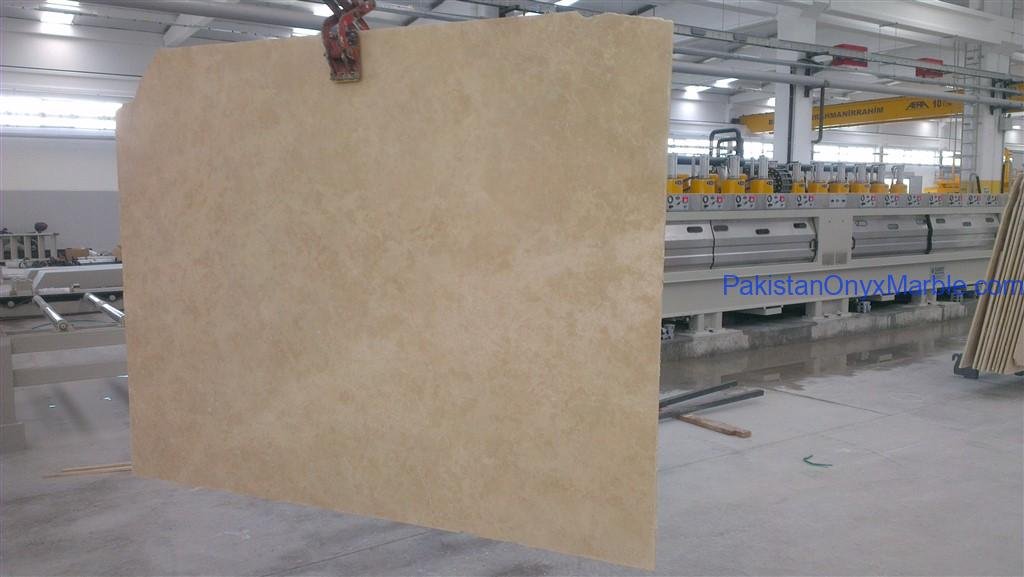
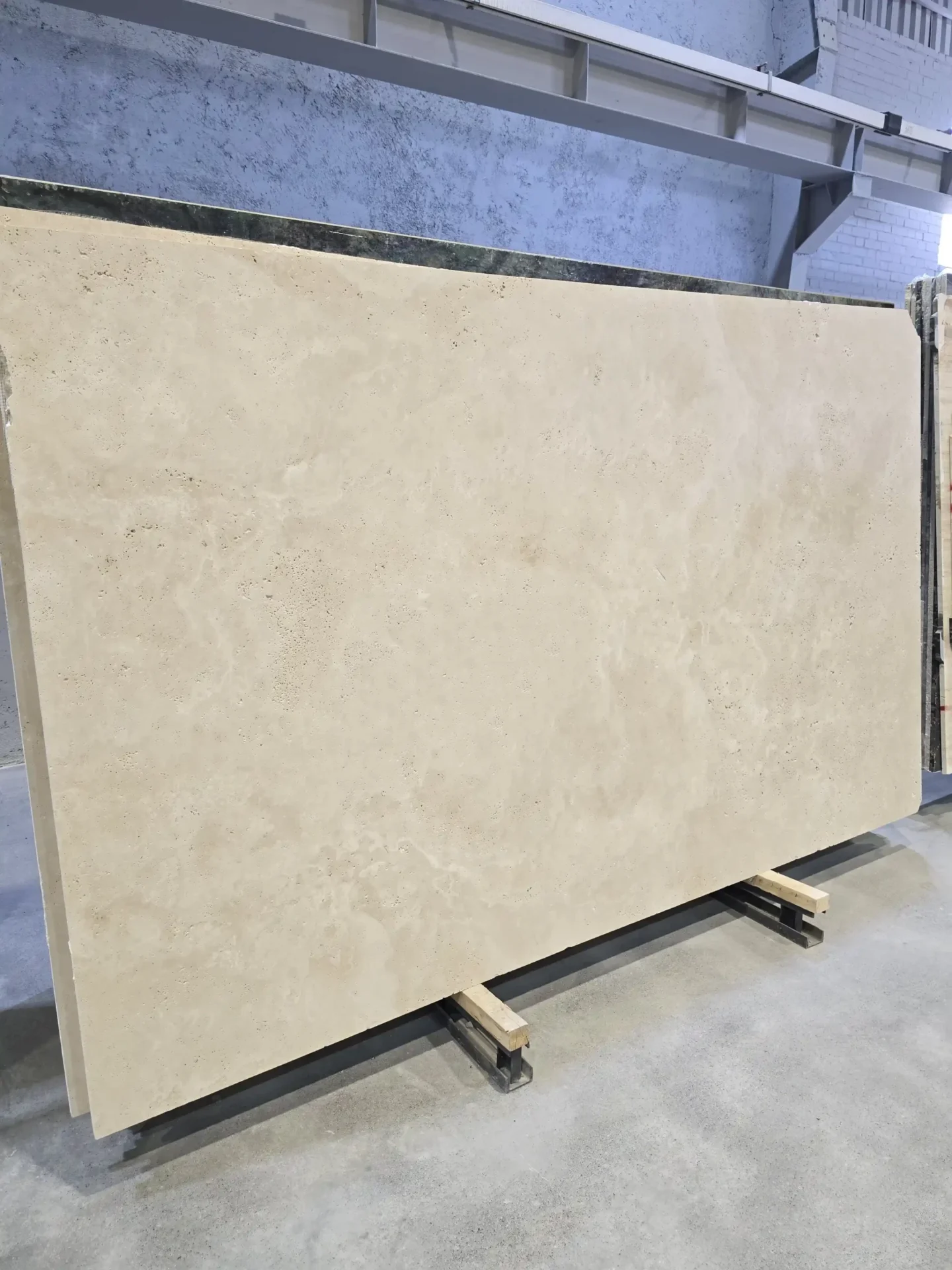
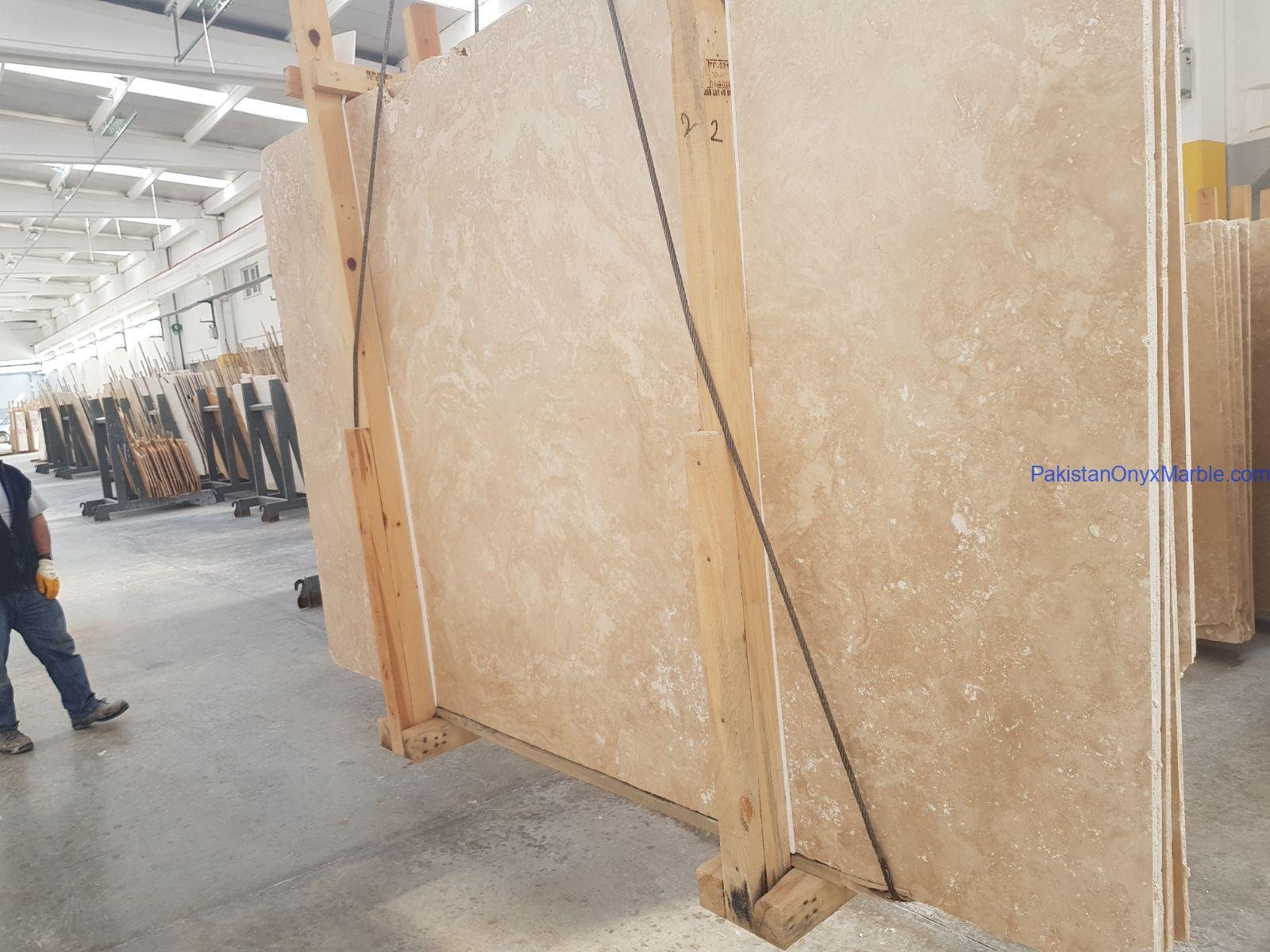
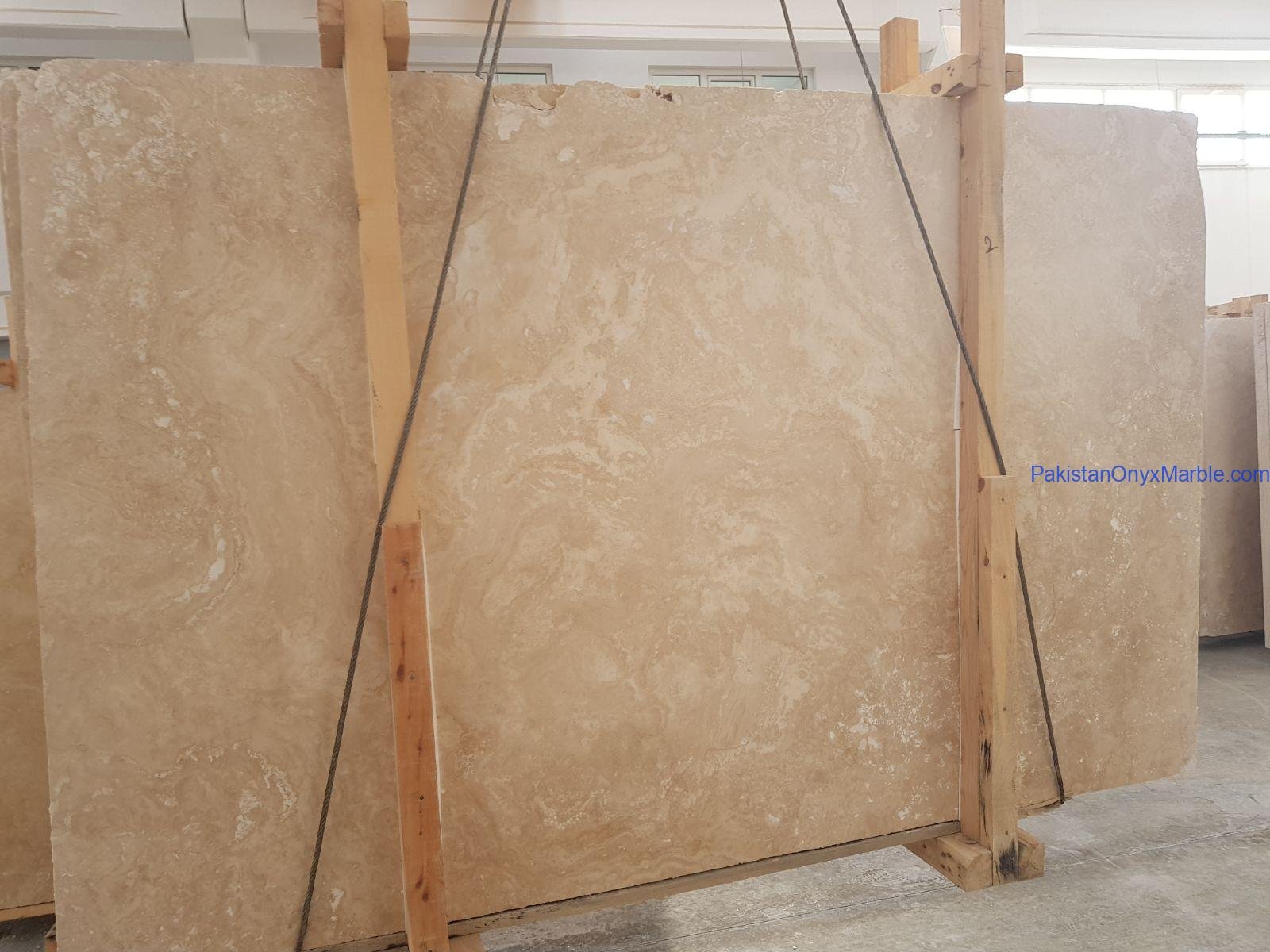
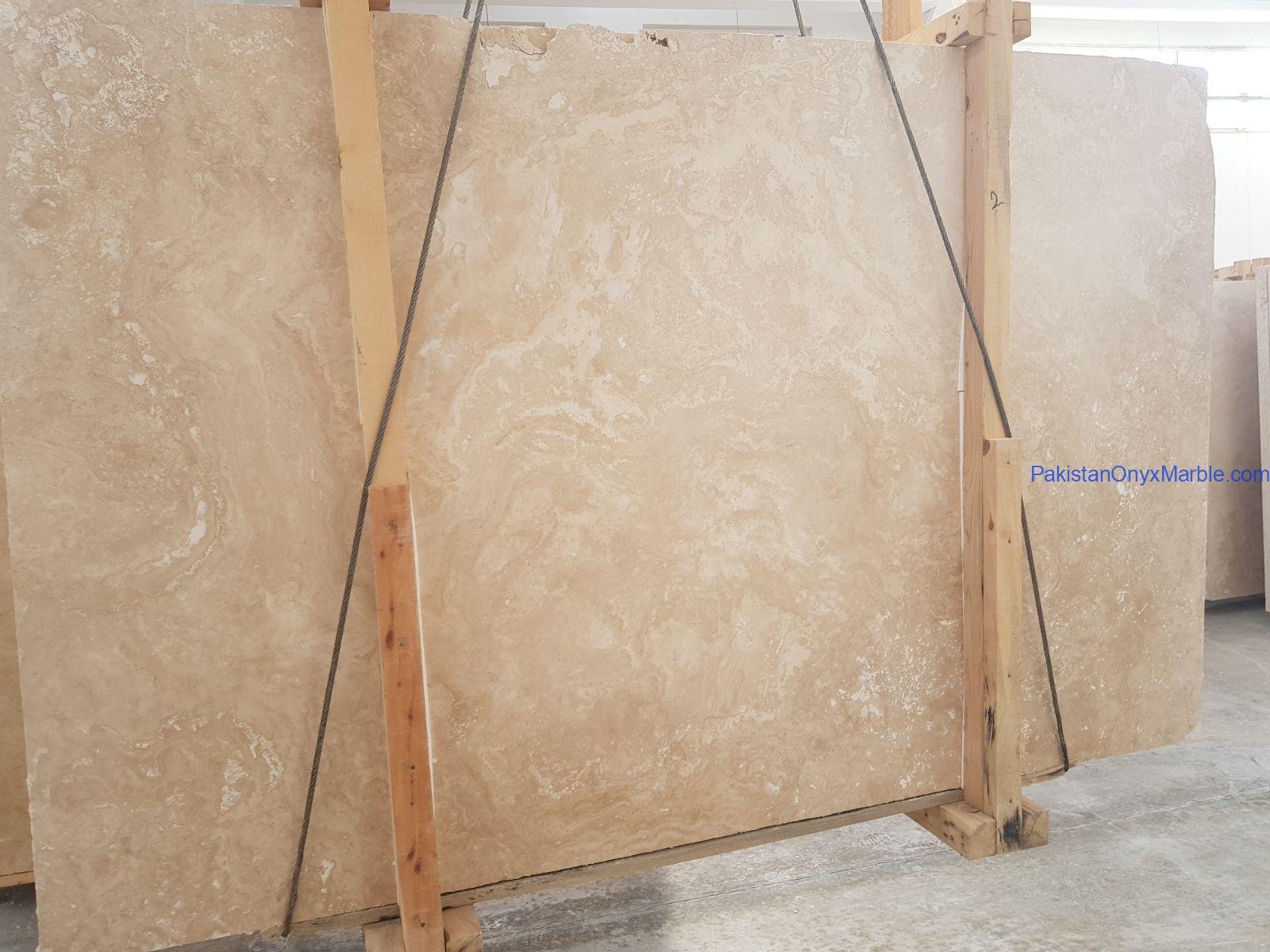
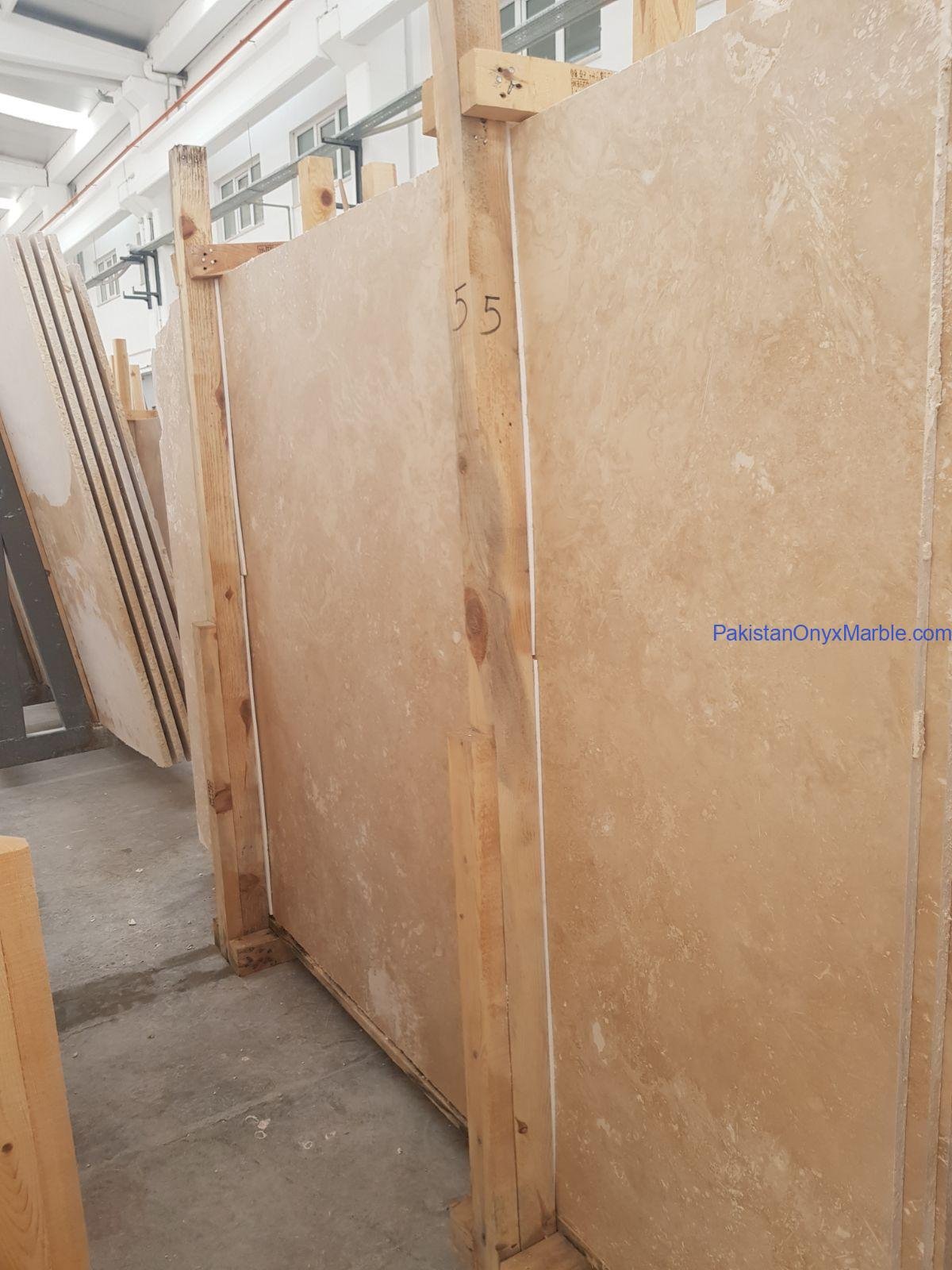
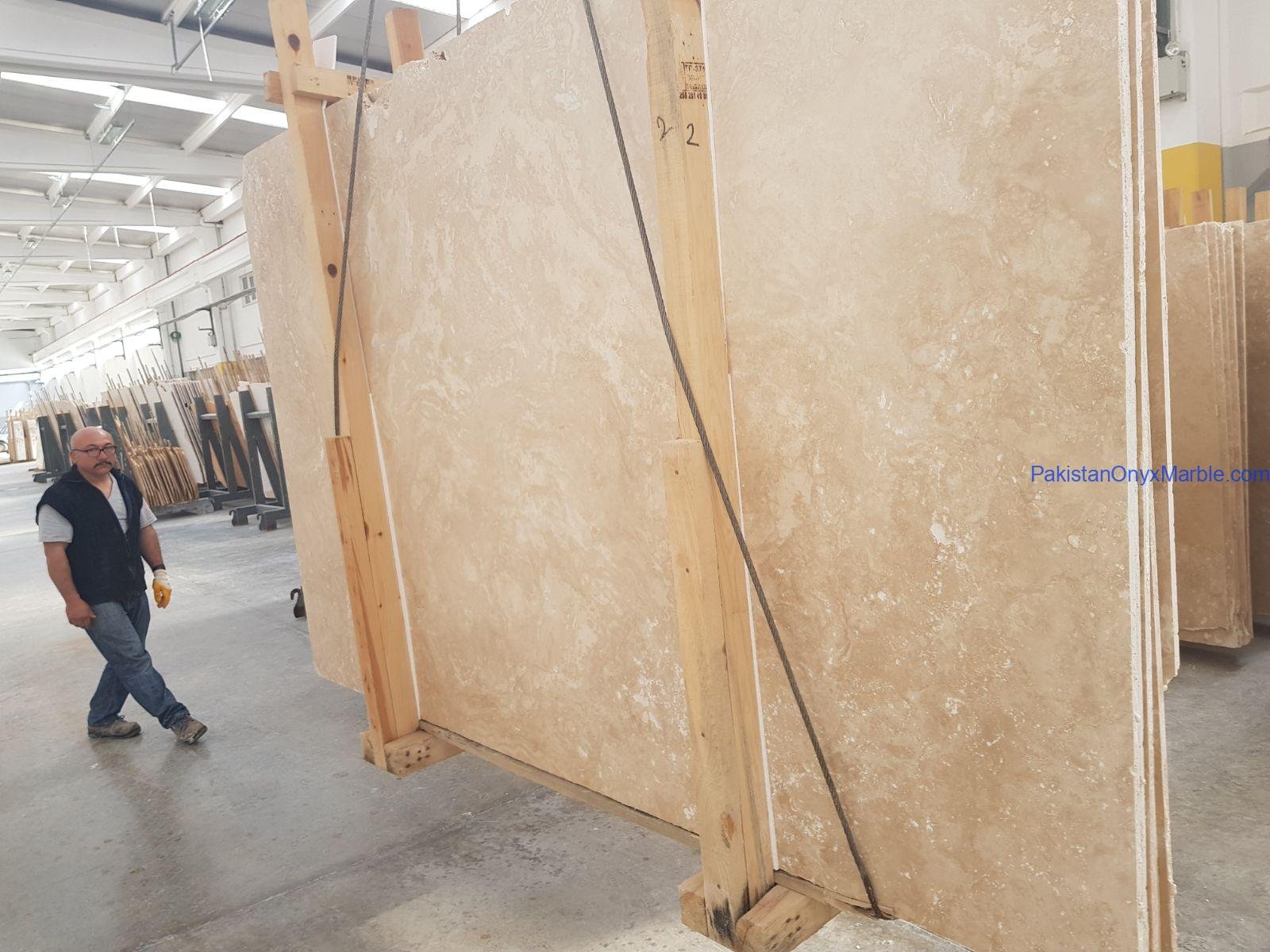
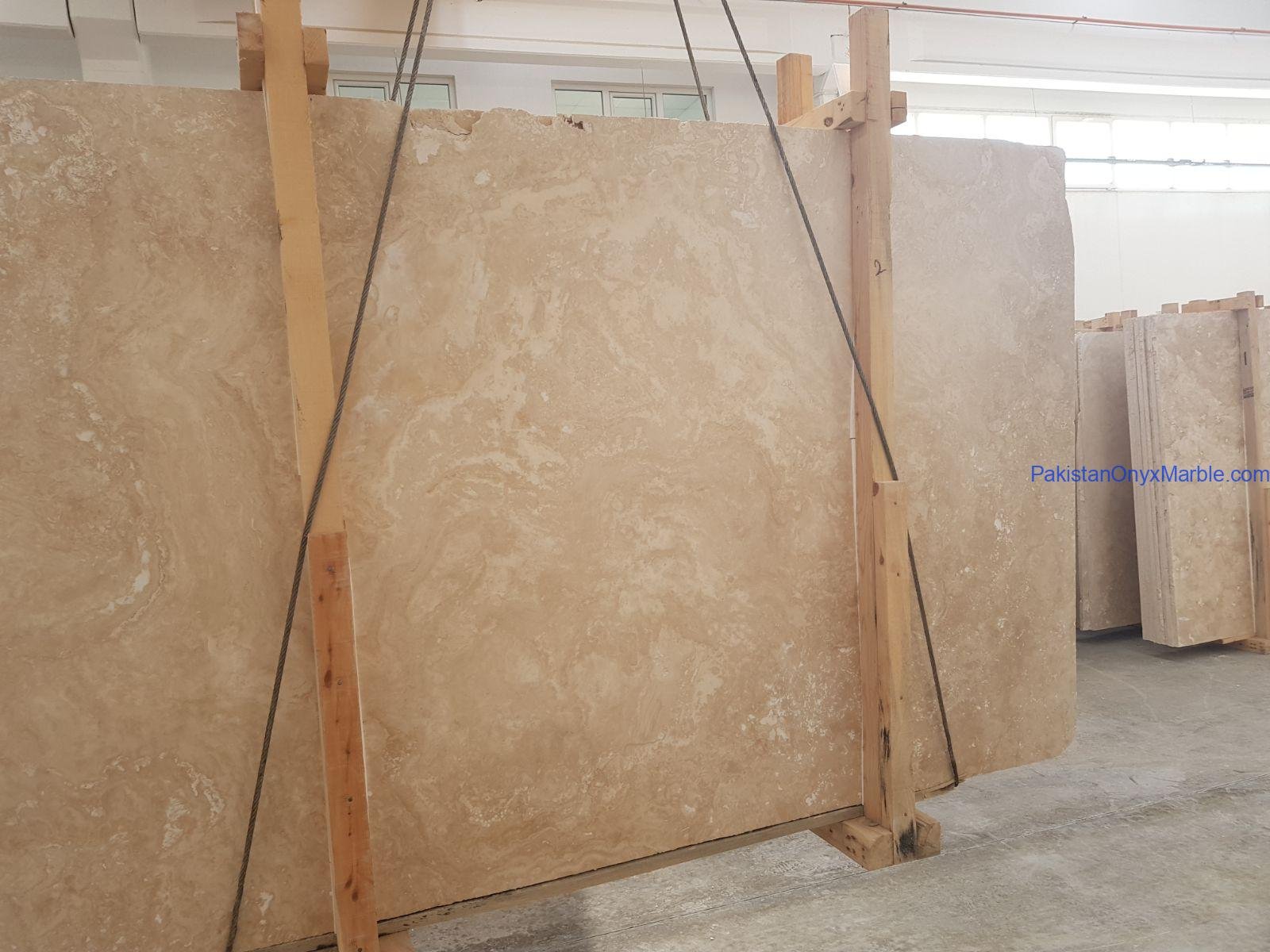
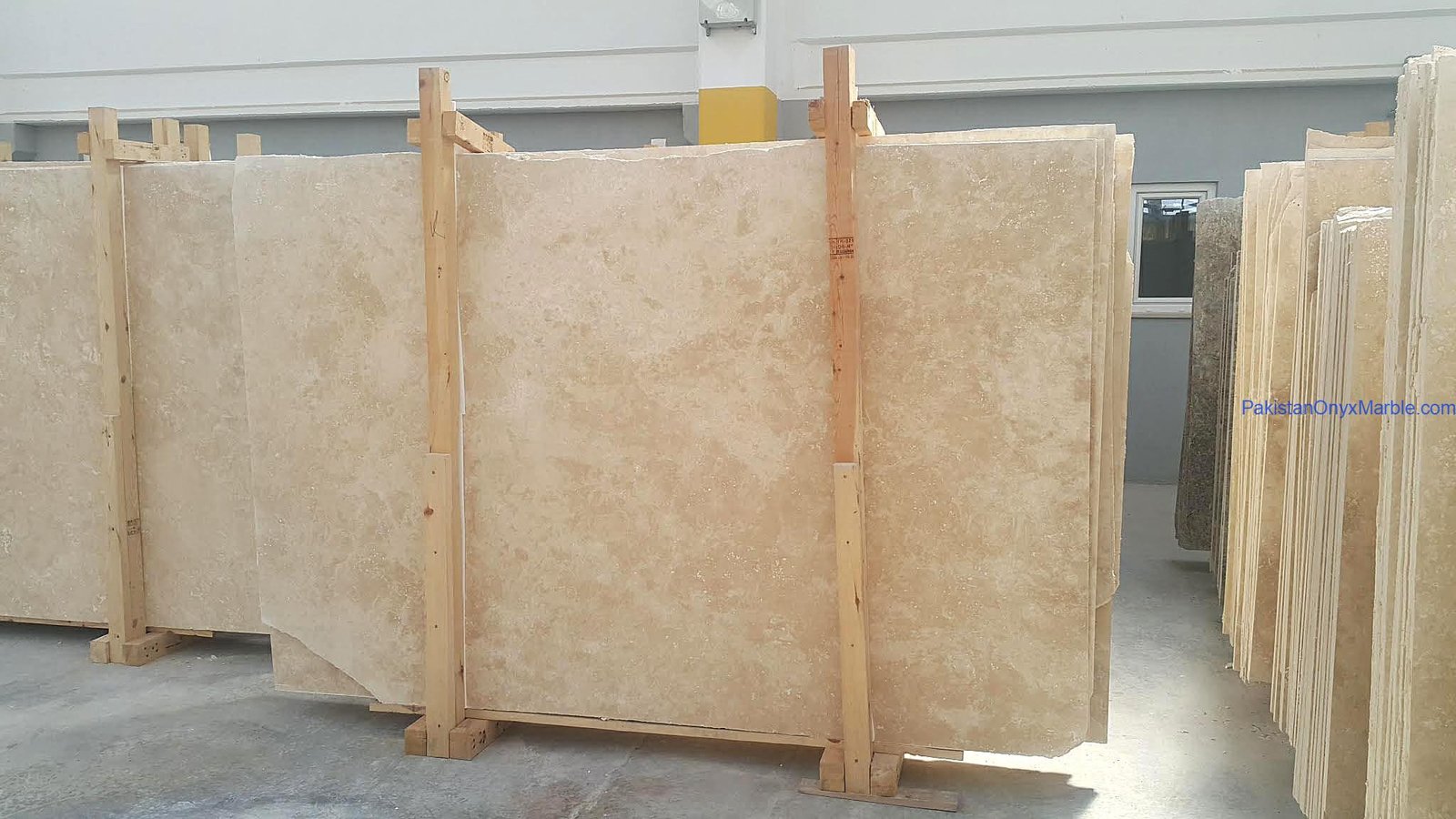
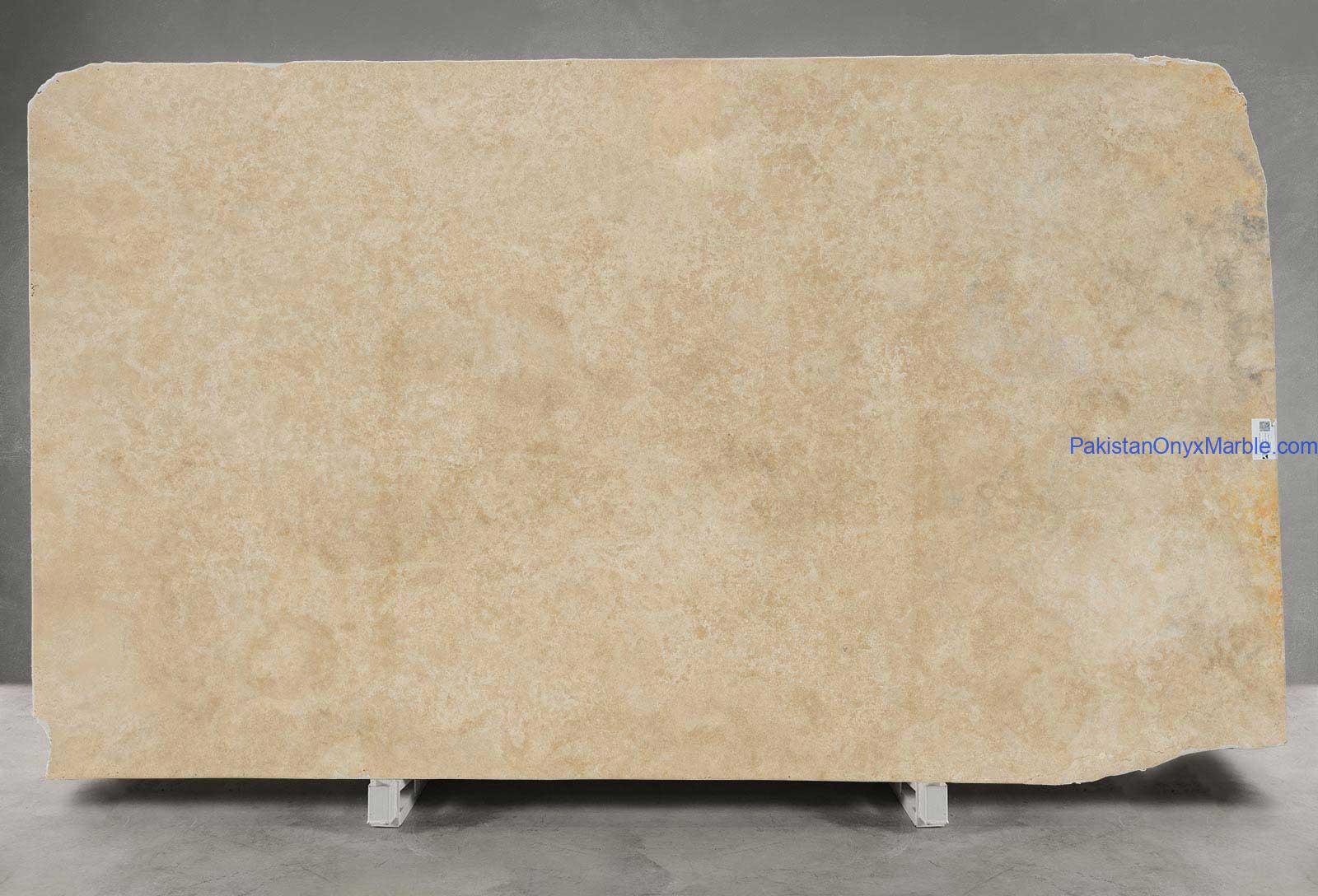
Travertine Slabs Beige Color Cross Cut
Beige Color & Cross-Cut Character
Beige Color: Ranges from light cream and ivory to warmer golden or nutty beiges. It provides a neutral, elegant, and timeless backdrop that complements a wide range of design styles, from traditional to modern.
Cross-Cut (Cross-Grain): This refers to how the stone block is sliced. Instead of cutting with the sedimentary layers (vein-cut, which shows long linear patterns), it is cut across the layers.
Resulting Appearance: This reveals the characteristic hollows and cavities of travertine as rounded, organic pores and a more chaotic, “busy” pattern of swirls and clouds. It highlights the stone’s natural formation and texture, giving it a more rustic, earthy feel compared to the linear elegance of vein-cut.
Common Sizes
Travertine slabs are available in dimensions similar to other natural stones. Beige cross-cut is widely stocked.
Standard Slab Sizes:
Length: Typically between 96″ to 120″ (8 to 10 feet).
Width: Commonly 48″ to 72″ (4 to 6 feet). 60″x120″ is a very popular modern size.
Thickness: For countertops, the standard is 2 cm (¾”) or 3 cm (1 ¼”). 3 cm is more robust for kitchens without needing a plywood substrate. For shower walls and other cladding, 1 cm (⅜”) thick slabs are also common.
Tile Sizes (if cut from slabs): Many of the slab finishes can also be applied to tiles. Common tile sizes cut from this material include 12″x24″, 24″x24″, 18″x36″, and large-format 24″x48″ or 36″x36″.
Popular Finishes for Beige Cross-Cut Travertine
The finish dramatically changes the stone’s look, feel, and performance.
Honed & Filled: The most popular finish for interiors.
Process: The surface is ground to a smooth, matte, non-reflective finish. The natural pores are filled with a matching resin or cement.
Look: Soft, velvety, contemporary. It evens out the color and provides a uniform surface.
Use: Ideal for flooring (less slippery than polished), countertops, shower walls, and interior cladding.
Polished:
Process: The stone is buffed to a high-gloss, reflective shine. Pores are usually filled.
Look: Elegant, formal, and deepens the color. The beige tones become richer. The cross-cut pattern becomes very vivid.
Use: Feature walls, bathroom vanities, interior flooring in low-traffic areas, and furniture tops. Can be slippery when wet.
Brushed / Tumbled:
Process: The stone is mechanically brushed or tumbled to wear down the edges and surface, creating an aged, textured, slightly rough feel. Pores remain open.
Look: Rustic, old-world, weathered. Enhances the stone’s natural texture and provides excellent slip resistance.
Use: Perfect for pool decks, patios, garden paths, and rustic-style interior floors.
Chiseled / Antiqued:
Process: The edges are hand-chiseled to create a rough, irregular perimeter. Often paired with a brushed or honed surface.
Look: Artisanal, old-world charm.
Use: Primarily for wall cladding, fireplace surrounds, and decorative borders to create a Mediterranean or rustic aesthetic.
Natural / Unfilled (Less Common for Slabs):
Process: The stone is cut and honed but the pores are left open.
Look: Very textured, natural, and porous. Requires more maintenance.
Use: Mostly for exterior applications where drainage or extreme slip resistance is needed, or for specific rustic interior features.
Primary Uses
Interior Uses:
Flooring: A top choice for whole-house flooring, especially in honed finish. It is durable and beautiful. Note: It is softer than granite and can etch from acids (lemon juice, vinegar), so sealing is crucial.
Bathrooms: Excellent for shower walls, shower floors (in smaller tiles), vanities, and tub decks. The honed finish is preferred for wet areas for slip resistance.
Kitchens: Used for countertops (honed is popular, but will show wear) and backsplashes. Be mindful of etching from acids.
Feature Walls: Creates a stunning, natural accent wall in living rooms or entries.
Fireplace Surrounds: Adds warmth and texture.
Exterior Uses:
Pool Decks & Coping: The brushed/tumbled finish is the #1 choice for pool decks due to its superior slip resistance and cool surface. Cross-cut’s texture is ideal for this.
Patios & Walkways: Provides a beautiful, durable surface that ages gracefully.
Exterior Cladding: For Mediterranean or rustic-style home exteriors.
Important Considerations & Maintenance
Sealing is Mandatory: Travertine is a porous calcium carbonate stone. It must be sealed with a high-quality penetrating sealer upon installation and re-sealed periodically (every 1-3 years depending on use) to resist staining, water absorption, and etching.
Etching: Vulnerable to acids (citrus, wine, vinegar, many cleaners). An etched spot will appear as a dull mark on a polished finish or a light spot on a honed finish. Using a honed finish helps camouflage this.
Durability: Softer than granite or quartzite. It can scratch and chip more easily, but this can add to its “lived-in” patina over time.
Variability: Natural stone has color and pattern variation from slab to slab. It’s essential to view and select your actual slabs (slab lot) for a project.
Our Advantages
Product Name
Beige Travertine Slabs – Vein Cut
Origin
Pakistan
Stone Type
Natural Travertine (Vein-Cut)
Color
Beige / Light Beige with linear horizontal veins
Cut Type
Vein-Cut (parallel to bedding layers for linear pattern)
Standard Slab Sizes
Thickness:
2 cm (20 mm)
3 cm (30 mm)
Custom: 4–6 cm (on request)
Length: 240 – 300 cm
Width: 140 – 185 cm
Approx. Weight
2 cm: 45–55 kg/m²
3 cm: 70–80 kg/m²
Available Finishes
Honed (most demanded)
Polished
Filled Honed
Filled Polished
Unfilled Honed
Brushed
Sandblasted / Bush-hammered (exterior use)
Surface Treatment
Resin filling or cement filling (optional)
Factory calibrated thickness
Edge trimming on request
Applications / Uses
Interior flooring
Wall cladding & feature walls
TV / media walls
Bathrooms & showers
Kitchen backsplashes & countertops
Stair treads & risers
Exterior façades (sealed finish recommended)
Hotels, restaurants, spas
Offices & commercial buildings
Furniture tops & décor manufacturing
Packing Details
Seaworthy wooden bundles
Plastic sheet + foam/rubber separation
Edge protection for long-distance shipping
Container Loading (Approx.)
20 ft container:
2 cm slabs: 350–450 m²
3 cm slabs: 220–280 m²
(Depends on slab size mix)
Shipping Terms
FOB Karachi Port
CNF / CIF on request
Payment Terms
30% advance, 70% before shipment
LC at sight (for large orders)
MOQ
100–150 m² per finish / thickness
HS Code
680291 (Travertine / Limestone slabs)